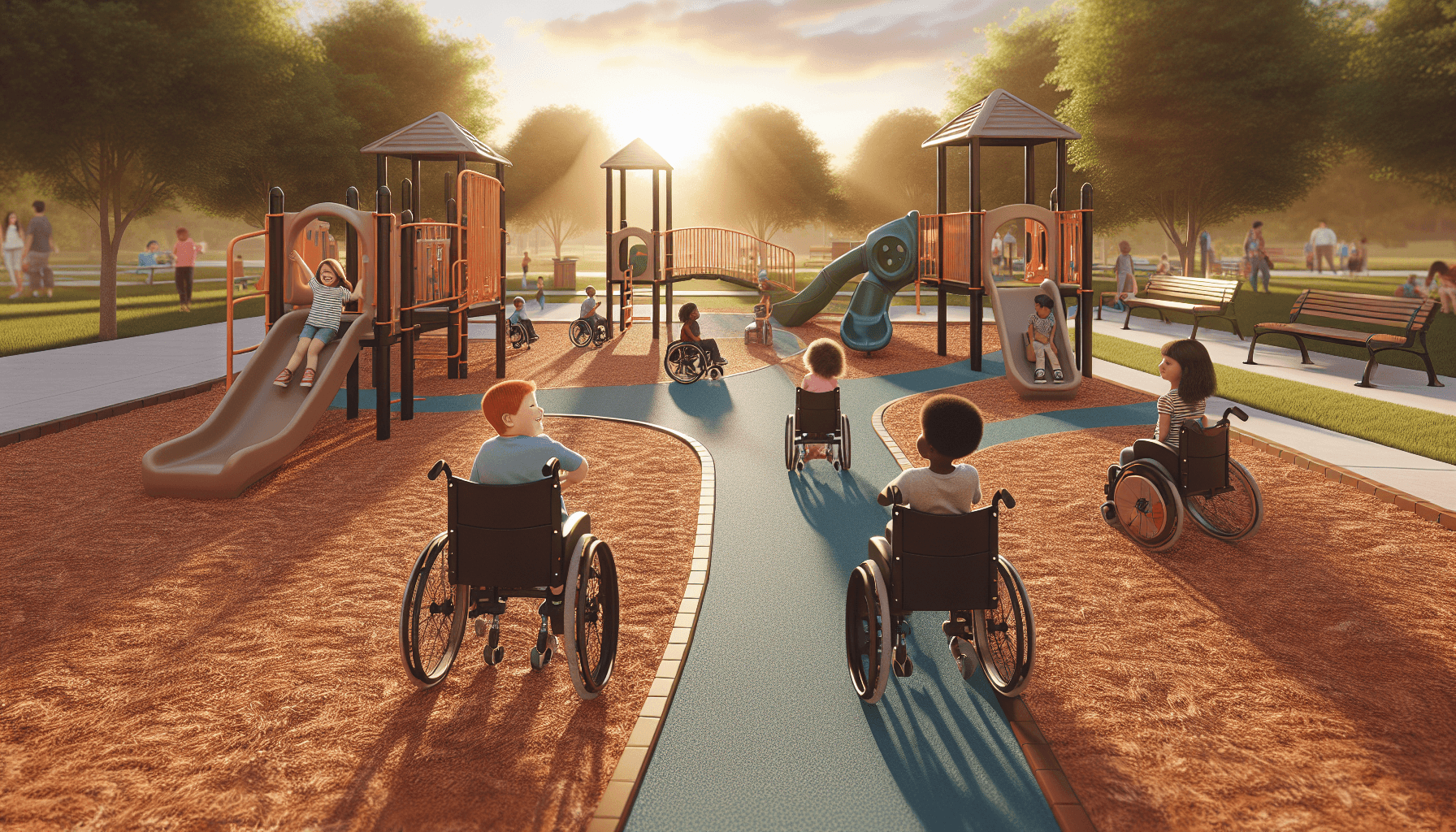
Understanding ADA Compliance for Playgrounds
When you're building or renovating a playground, ADA compliance isn't just a checkbox — it's federal law. The Americans with Disabilities Act requires playground surfaces to be wheelchair accessible, and the standards are specific. The good news? With the right surfacing choice, meeting ADA requirements is straightforward.
The 2010 ADA Standards for Accessible Design reference ASTM F1951 as the test method for wheelchair accessibility on playground surfaces. Your surfacing must allow a wheelchair to roll across with minimal force, measured in straight-ahead force and turning force. If you're choosing between mulch types, this is where engineered wood fiber and rubber mulch separate themselves from shredded wood.
The Technical Requirements (Without the Jargon)
Here's what matters for your crew:
- Accessible routes must connect playground entry points to elevated play components and ground-level play areas
- Ground-level accessible routes require a firm, stable surface that allows wheelchair passage
- ASTM F1951 testing measures the work per foot required to propel a wheelchair — passing means ≤204 lbf·ft for straight travel and ≤309 lbf·ft for turning
- Surface continuity matters — gaps, openings, and level changes can't exceed ½ inch
Rubber mulch and engineered wood fiber (EWF) consistently pass ASTM F1951 when installed correctly. Shredded wood mulch typically fails. If you're bidding a public playground project, assuming you can use cheap shredded wood is how you end up eating change orders.
Accessible Routes: Where Surface Choice Really Matters
ADA requires two types of accessible routes on playgrounds:
1. Ground-level accessible routes: Connect the playground entrance to at least one of each type of ground-level play component. These routes must be at least 60 inches wide and maintain the accessible surface standard.
2. Elevated accessible routes: If you're installing elevated play structures (ramps, transfer systems, or accessible climbers), the route to those access points must also meet accessibility standards.
The critical detail: Your mulch depth, compaction, and containment all impact whether the surface stays accessible over time. A 6-inch depth of rubber mulch installed over compacted subgrade will pass ASTM F1951. That same depth, installed over loose soil and allowed to migrate, won't.
Rubber Mulch vs. Engineered Wood Fiber for ADA Compliance
Both rubber mulch and engineered wood fiber can meet ADA accessibility requirements when installed properly. Here's what your crew needs to know:
Rubber mulch advantages:
- Maintains firmness over time — doesn't decompose or compact unevenly
- Stays in place better (heavier particles resist wind and displacement)
- Less frequent top-offs needed to maintain accessible depth
- Passes ASTM F1951 at 6-8 inch depths when properly installed
Engineered wood fiber advantages:
- Lower material cost upfront
- Natural aesthetic some clients prefer
- Also passes ASTM F1951 when fresh and properly maintained
The maintenance difference: EWF decomposes. That means annual inspections and top-offs are non-negotiable to maintain accessibility. Rubber mulch holds its structure for years. If you're bidding a contract that includes maintenance responsibility, factor that in.
Installation Details That Keep You Compliant
ADA compliance starts before your truck unloads. Here's the installation checklist:
-
Prepare the subgrade: Compact soil to a firm base. Loose subgrade = surface migration = failed accessibility over time.
-
Install edging/containment: ADA doesn't require edging, but practical compliance does. Without containment, mulch migrates off accessible routes and creates level changes at borders.
-
Achieve proper depth: For rubber mulch, 6-8 inches over compacted subgrade meets both ASTM F1292 (fall safety) and F1951 (accessibility). Going thinner might pass safety but fail accessibility.
-
Grade for drainage: Standing water on accessible routes is an ADA violation. Slight slope (1:50 to 1:20) allows drainage while remaining accessible.
-
Mark accessible routes during install: If you're working with a maintenance crew that doesn't understand accessibility, mark the designated routes clearly. They need to know where depth and firmness matter most.
Common ADA Surfacing Mistakes (and How to Avoid Them)
Using shredded wood mulch on accessible routes: It won't pass F1951. If the spec calls for wood surfacing and ADA compliance, clarify with the owner that you're pricing engineered wood fiber, not shredded wood. The cost difference is significant, and the compliance difference is binary.
Inconsistent depth: Your mulch depth at the accessible route can't be 4 inches while the fall zones are 9 inches. Accessibility and safety depths must overlap. Plan your installation to achieve both.
Ignoring edge transitions: A 2-inch drop from mulch to concrete at the playground entrance is a violation. Bevel edges or install ramps where necessary.
Skipping post-installation testing: Some jurisdictions require third-party ASTM F1951 testing after installation. Know your contract requirements before you pour the mulch.
Why This Matters for Your Bid
Public playgrounds built with federal funds (CDBG grants, parks budgets, school district projects) must comply with ADA. If your bid assumes non-compliant materials, you have three options when the inspector shows up:
- Rip out the surface and reinstall (you eat the cost)
- Install accessible mats over your non-compliant surface (expensive, looks terrible, client is angry)
- Argue with the inspector (you lose, then pick option 1 or 2)
Bidding compliant surfacing from the start costs more upfront. It's also the only option that doesn't involve a change order, an angry client, or a re-do.
Maintaining ADA Compliance After Installation
Your responsibility doesn't end when the crew packs up. ADA compliance is ongoing:
- Annual inspections of accessible routes for firmness, depth, and level changes
- Top-offs as needed to maintain depth (more frequent for EWF, less for rubber mulch)
- Raking to redistribute mulch that migrates from accessible routes
- Replacing decomposed material (EWF requires replacement every 3-5 years; rubber mulch lasts 10+ years)
If you're quoting a maintenance contract, build these requirements into your pricing. A playground that passes inspection in year one but fails in year three is still your problem if the contract says maintain ADA compliance.
GetMulch.com: Compliant Surfacing, Delivered When You Need It
We deliver ADA-compliant rubber mulch and engineered wood fiber to playground builders across the region. Your mulch shows up when your crew does — not three weeks late when you're already behind schedule.
Need help specifying surfacing for an upcoming ADA-compliant project? We work with contractors daily on accessibility, fall safety, and installation best practices. Call us before you bid, and we'll make sure your material choice keeps you compliant and profitable.