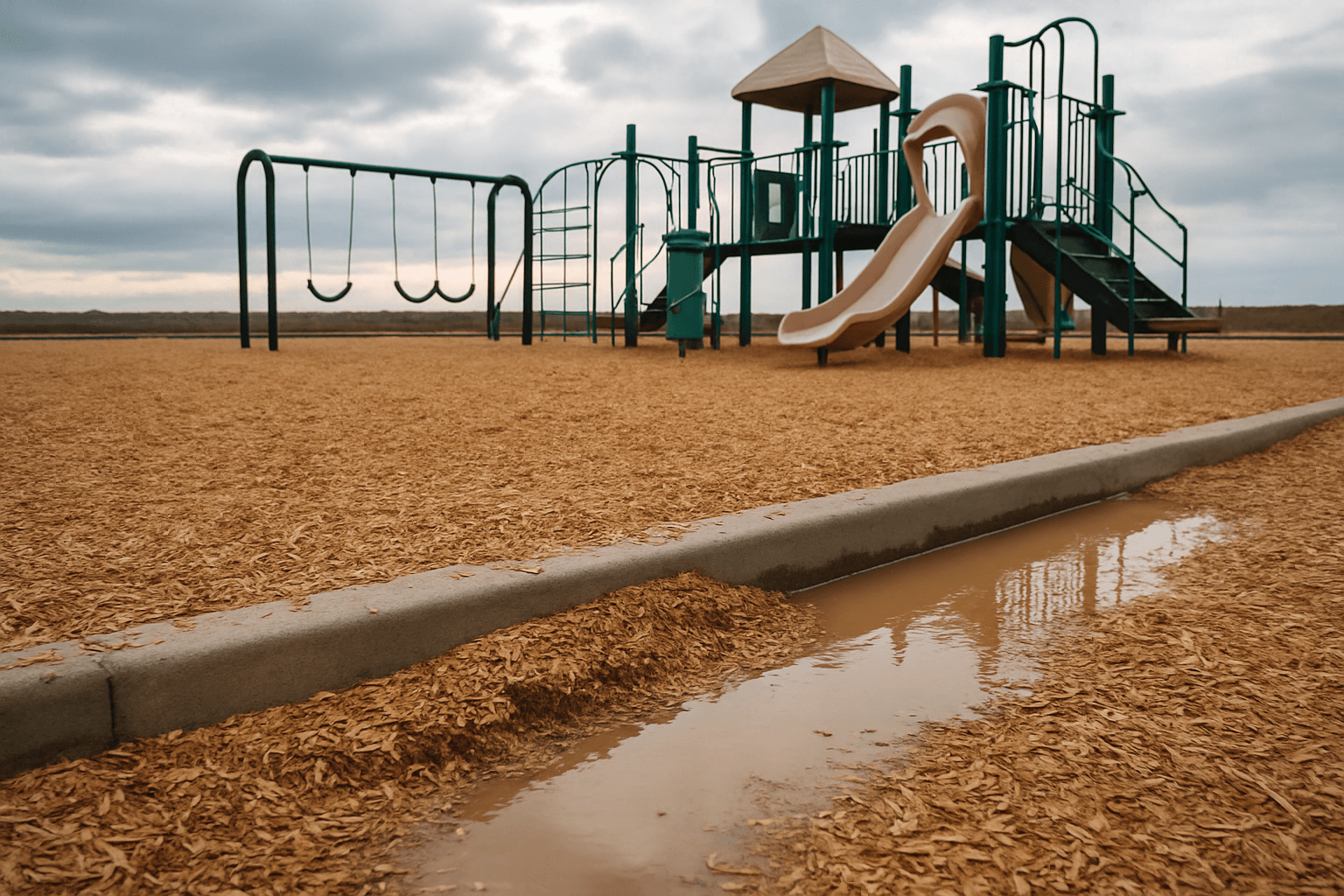
You finish installing a swing set in late October, depth checks pass, documentation is clean. Come April, you're back on-site and the safety inspector pulls out a depth gauge. The EWF under the swings reads 7 inches. You installed it at 12. Where did 5 inches go?
The answer is almost always weather. Rain washed some out. Freeze cycles loosened the rest. Kids packed the remainder down all fall. By spring, what looked like a solid install is now a liability.
Weather is the biggest threat to playground mulch compliance that most crews aren't tracking closely enough. Here's what's actually happening to your surfaces, season by season, and what you need to do about it.
Summer: Heat and Heavy Use Are Compacting Your Mulch
Hot weather on its own won't destroy a playground surface. The real damage comes from the combination of heat and traffic. During peak season, kids are on the equipment more hours per day, more days per week, and the mulch doesn't get a break to decompress.
EWF compacts under weight. That's just physics. But heat speeds it up by drying the fibers out, reducing the springiness that keeps loose-fill material from packing down permanently. What was 12 inches of uncompacted EWF at install can read 9 or 10 inches by August without a single piece of mulch leaving the site.
The problem: ASTM F1292 sets critical height ratings based on installed depth at a specific compaction level. Compacted mulch doesn't absorb impact the same way fresh mulch does. A surface that passed inspection at install may no longer meet the critical height rating for your equipment by mid-summer.
What to do:
- Check depth in high-traffic zones monthly during summer. Focus on the swing zone directly under seats, the landing area at the base of slides, and climbing frame perimeters. These are where compaction hits fastest.
- If measured depth drops more than 2 inches below your target depth, top off. Don't wait.
- Log your measurements. If a claim ever comes in, showing a documented maintenance log is the difference between a defensible position and an exposed one.
Rain: Displacement and Washout Are the Silent Killers
A solid week of rain won't flood your mulch out completely, but it moves material in ways that aren't obvious until you look closely. Loose-fill mulch - both EWF and rubber - shifts toward the lowest points in the containment bed. That means the edges and downslope corners build up, while the areas directly under equipment (which are slightly elevated due to heavy foot traffic compaction) get thinner.
On sites with inadequate edging or slopes greater than a few degrees, heavy rain accelerates this. We've seen sites lose 3 or 4 inches of effective depth under the equipment just from repeated washout and displacement over a season.
Rubber mulch handles rain differently than EWF. It doesn't absorb water and is heavier, so it doesn't migrate as easily. EWF, especially finer grades, moves more readily. If your site uses EWF and has any slope at all, rain is a bigger risk factor.
What to do:
- After any major storm event (an inch or more of rain), walk the site. You're looking for mulch piled against the containment boards at the perimeter and thin spots in the fall zones.
- Use a depth stake or penetrometer to spot-check the primary fall zones before kids get back on the equipment.
- Redistribute displaced mulch from the edges back toward center. It's usually still on-site - just in the wrong place.
- Check that containment edging is still holding after heavy rain. Heaved or shifted borders let mulch escape during the next storm.
Winter: Freeze-Thaw Cycles and Spring Surprises
A hard winter does two contradictory things to playground mulch: it temporarily hardens frozen surfaces (which removes the cushioning effect entirely) and it loosens compacted EWF through repeated freeze-thaw cycling (which can actually restore some depth).
The first issue is the more serious one. Frozen mulch is rigid. A child falling on frozen EWF or rubber mulch at 12 degrees has essentially fallen on the ground. Most liability-aware facility managers close playground access when temps drop below freezing, which is the right call. CPSC guidance backs this up.
The second issue - the freeze-thaw loosening effect - is actually good news in moderation. If you had a heavily compacted EWF surface going into winter, the expansion-contraction cycles of freezing water in the fiber matrix can break up compaction and restore some of the material's original cushioning properties. Don't count on it as a maintenance strategy, but don't be surprised when you see better depth readings in March than you did in October.
What winter definitely does: it loosens and heaves containment edges. Frost moves through the ground and lifts edging boards, creates gaps where mulch escapes, and shifts borders that were set straight.
What to do:
- Schedule a full spring inspection before reopening after winter. Every playground. Every time.
- Check containment edge alignment and reset any heaved sections before mulch can escape through gaps.
- Measure depth in all primary fall zones with a depth gauge or penetrometer. Don't eyeball it.
- Document the spring baseline depth. This gives you a starting point to track compaction and displacement through the coming season.
Tying It to Compliance
ASTM F1292 tells you what depth your surface needs to maintain for a given critical fall height. What it doesn't do is maintain that depth for you. The standard sets the target; weather and use erode it over time.
Most playground injury claims don't cite a failure at installation. They cite inadequate depth at the time of the incident. The difference between a defensible claim and a settlement is usually whether you had a maintenance program that would have caught the deficiency before it became a problem.
A basic weather-responsive maintenance schedule looks like this:
- Monthly in summer: Depth check in high-traffic zones, top off if below threshold, log results
- After any major storm: Walk the site, redistribute displaced material, check containment
- End of season: Full depth check, document baseline, identify zones needing top-off before winter
- Spring reopening: Full inspection before kids get on equipment, reset containment, establish new baseline
That's it. It doesn't take a dedicated team. It takes a site visit with a depth gauge and a log sheet.
Getting the Material Right
Maintenance is easier when the material holds up well. IPEMA-certified engineered wood fiber and rubber mulch are designed to maintain performance characteristics over time. Non-certified or low-quality materials compact faster, migrate more readily in rain, and don't maintain the critical height ratings they started with.
GetMulch delivers IPEMA-certified EWF and rubber mulch with compliance documentation, across all project sizes. Whether you're topping off a single site or managing a multi-location portfolio, we make sure the material you get meets the specs your surfaces need.
Get a quote at getmulch.com/get-a-quote.