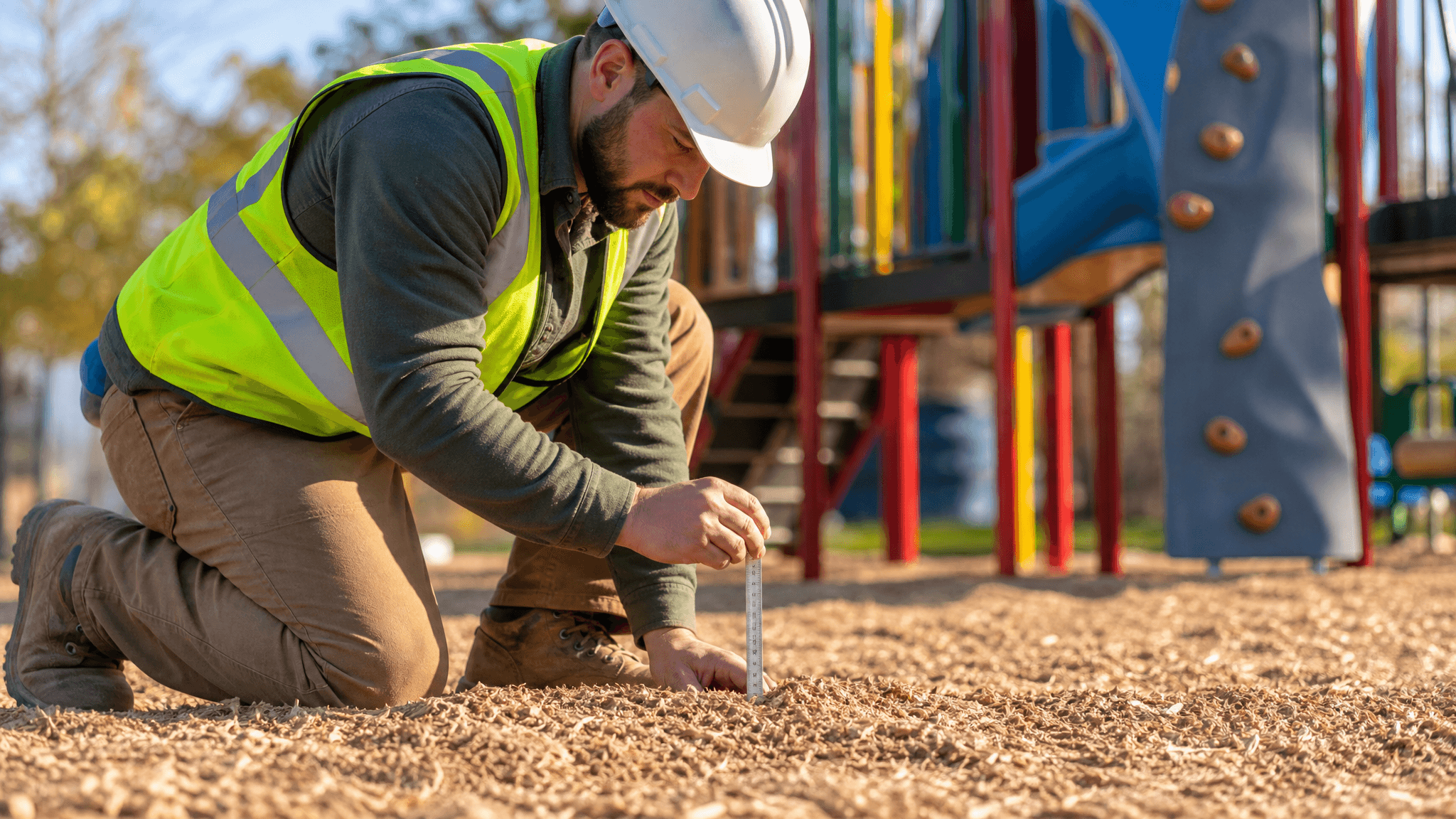
Depth Is the Variable You Control
The most common playground safety violation isn't the wrong material, it's the wrong depth.
ASTM F1292 doesn't tell you to use engineered wood fiber. It tells you how much of it you need based on how far a child can fall from the equipment. Get that calculation wrong, and a surface that passed material testing fails compliance before the playground opens.
This guide is your field reference. Bookmark it. Put it in the work truck.
How ASTM F1292 Defines the Relationship
ASTM F1292 establishes a surface's critical height: the maximum fall height from which the surface can protect against a life-threatening head injury. A surface passes if it keeps impact forces below defined G-force and Head Injury Criterion (HIC) thresholds during standardized drop testing.
Two inputs determine compliance:
- The material: each product carries a certified critical height rating at a specific installed depth
- The installed depth: deeper installation extends critical height protection, up to the material's tested maximum
This is why depth and fall height are inseparable. You cannot evaluate one without knowing the other.
Depth Reference by Fall Height
Use this table as your starting point for installation planning. Material-specific adjustments follow.
| Fall Height | Minimum EWF Depth | Minimum Rubber Mulch Depth | PIP Depth | |---|---|---|---| | Up to 4 ft | 6 inches | 4 inches | Per manufacturer spec | | Up to 5 ft | 6 inches | 6 inches | Per manufacturer spec | | Up to 6 ft | 9 inches | 6 inches | Per manufacturer spec | | Up to 8 ft | 9 inches | 9 inches | Per manufacturer spec | | Up to 10 ft | 12 inches | 9 inches | Per manufacturer spec | | Up to 12 ft | 12 inches | 12 inches | Per manufacturer spec |
These are minimums at installation, before settling and compaction. For loose-fill materials, install deeper than your minimum. See below.
Material-Specific Guidance
Engineered Wood Fiber (EWF)
EWF is the most widely specified loose-fill surface on commercial playgrounds, and the one most likely to fail re-inspection if initial depth isn't accounted for properly.
What changes over time:
- EWF compacts 20-25% in the first 6-12 months under use
- Displacement from high-traffic zones ( below swings, at slide exits ) can reduce effective depth by 3-4 inches within a single season
- Rain accelerates initial compaction in the first 30-60 days
Practical rule: Install 20% above your target maintenance depth. If compliance requires 9 inches, install at 11 inches. If you need 12 inches, install at 14-15 inches.
Always spec IPEMA-certified EWF. Certification documents the material's tested critical height at specific depths, that documentation is your proof of compliance.
Rubber Mulch (Shredded Rubber)
Rubber mulch has a different failure mode than EWF: migration, not compaction.
- Rubber migrates laterally, especially at slide exits and swing fall zones
- Wind displacement is greater than EWF because rubber mulch is lighter per cubic foot
- Perimeter containment edging must be rated for rubber migration, with at least 3 inches above the finished mulch surface
Practical rule: Installed depth equals your target maintenance depth. Compaction isn't the issue, lateral migration is. Plan for annual top-off in high-traffic zones regardless of initial depth.
Poured-In-Place (PIP) Rubber
PIP is engineered to a fixed thickness at installation. There's no compaction, no migration.
- Depth is determined by the manufacturer's testing data at your required fall height
- You cannot add depth after the pour, verify specifications against equipment fall heights before contracting
- Inspect seams and edges annually, degradation at joints is the primary long-term failure mode for PIP
The Zones That Fail First
Depth requirements apply across the entire use zone, but not all areas wear evenly. These zones lose depth fastest and should be prioritized during every inspection:
Swing fall zones: Extends 2x the pivot height in front of the seat. This is the highest-impact, highest-frequency zone on most playgrounds. Measure depth here at every quarterly inspection.
Slide exits: Children gain speed on the slide and land at the exit point. Foot-dragging compounds material displacement. Check monthly during peak season.
Climbing structure perimeters: The full use zone perimeter ( not just the obvious entry/exit points ) must meet the compliance depth for the structure's highest accessible platform.
Tip: When you hand off a completed installation, include a site sketch marking depth-critical zones. It tells the client's maintenance crew exactly where to probe first. That sketch becomes part of your compliance documentation.
Common Depth Errors to Avoid
Installing to spec, not to use. The ASTM minimum assumes average conditions. A high-volume urban park playground in year-round use needs more initial depth than a low-traffic HOA property. Know your site before you calculate your order.
Skipping displacement verification before handoff. If three weeks passed between installation and handoff ( with rain, settling, and foot traffic ) remeasure before you sign off. What was 12 inches at pour may already be 10.
Single-point measurements. Depth at the edge of the fall zone doesn't tell you depth under the equipment. Take 5-6 probe measurements per critical zone. Minimum, average, and low readings all matter.
No documentation at installation. Your depth readings on day one are your proof of compliance. If a claim surfaces two years later, those records are the difference between a defensible position and an exposure.
Document Before You Leave the Site
Required at every installation:
- Material name, supplier, and IPEMA certification number
- Measured depth by zone (minimum 5 probes per critical zone)
- Fall height for each piece of equipment (pull from equipment spec sheets)
- Date of installation and crew lead signature
- Photographs of depth gauge at each measurement point
GetMulch provides IPEMA certification and delivery documentation with every order. Pair that with your installation depth log and you have a complete, defensible compliance record.
Pre-Departure Checklist
Before your crew wraps and leaves the site:
- [ ] Depth measured in all fall zones (5+ probes per zone)
- [ ] EWF zones installed at 20%+ above minimum depth
- [ ] Rubber mulch containment edging set 3+ inches above finished surface
- [ ] PIP thickness verified against manufacturer specification
- [ ] Fall heights confirmed against equipment spec sheets
- [ ] All depth measurements logged and photographed
- [ ] Client briefed on first-year compaction and recommended top-off schedule
GetMulch Delivers Certified Material: You Set the Depth Right
GetMulch supplies IPEMA-certified EWF and rubber mulch with documented critical height ratings and full delivery paperwork. Tell us your fall heights and site conditions, we'll help you spec the right material and the right volume.
Request a quote at getmulch.com/get-a-quote.