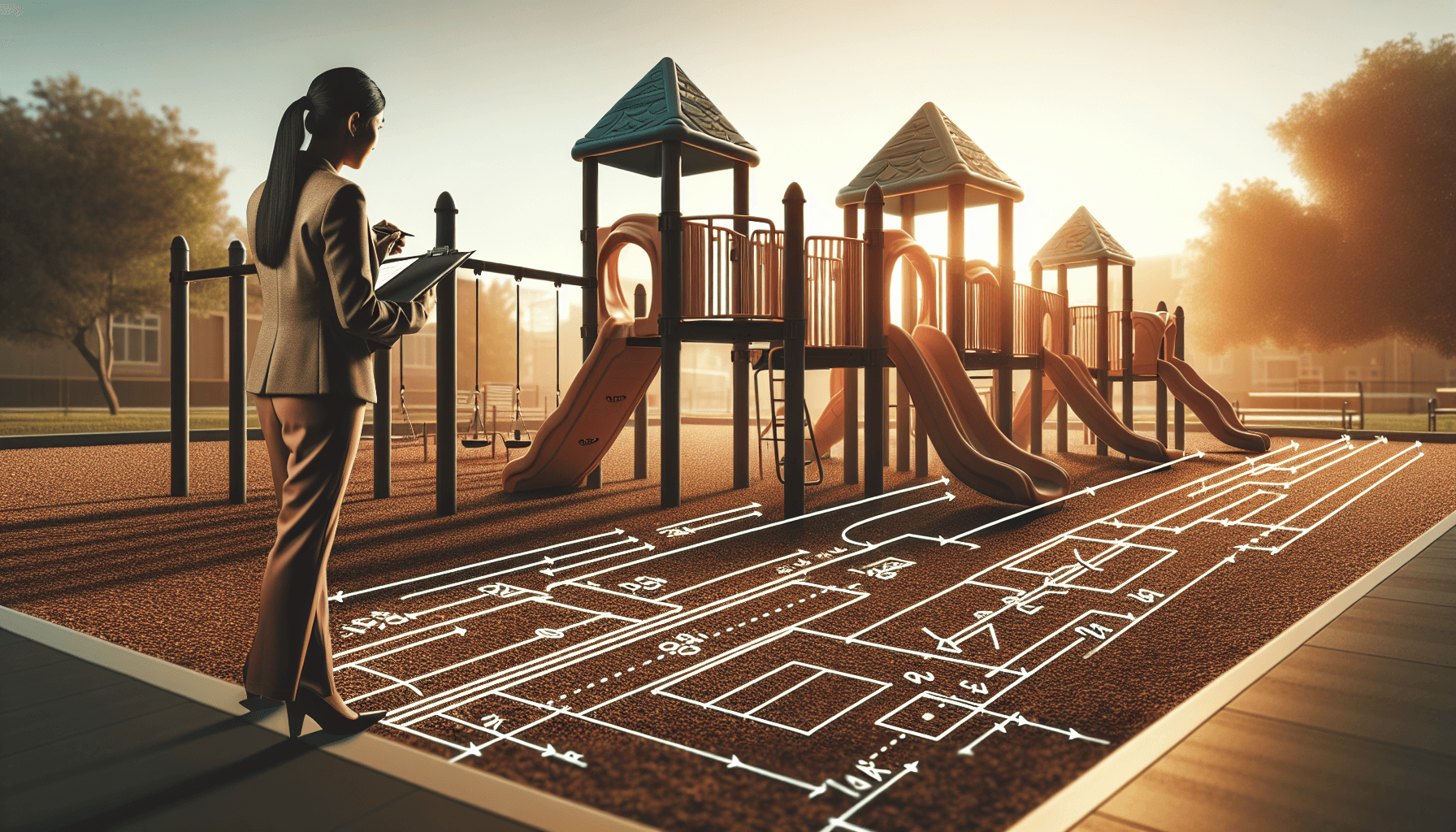
What Is Critical Fall Height?
Critical fall height (CFH) is the maximum height from which a life-threatening head injury would not be expected to occur if a child falls onto the playground surfacing material. It's the cornerstone of playground safety calculations and the primary metric you'll use when specifying mulch depth for any installation.
Simply put: CFH tells you how high a piece of equipment can be before the surfacing beneath it becomes inadequate for protecting a falling child. If your swing set platform is 8 feet high but your mulch only provides 6 feet of CFH protection, you've got a safety gap—and a liability exposure.
The ASTM F1292 Connection
ASTM F1292 is the standard test method for measuring impact attenuation of surfacing materials installed in playgrounds. This is the lab test that determines a material's CFH rating. Here's what happens:
A test laboratory drops a standardized headform (simulating a child's head) from various heights onto your surfacing material. Sensors inside the headform measure G-max—the peak deceleration force during impact. ASTM F1487 (the standard for playground equipment) requires that G-max not exceed 200, which represents the threshold for life-threatening head injury.
The critical fall height is the maximum drop height where the surfacing keeps G-max at or below 200. For example, if your rubber mulch passes the test at 10 feet but fails at 11 feet, its CFH is 10 feet.
How to Calculate Required Surfacing Depth
The actual calculation is straightforward once you know two things: the highest accessible point on your playground equipment and the CFH rating of your surfacing material.
Step 1: Measure the fall height—the maximum vertical distance a child could fall from any elevated surface. For swing sets, this includes the arc height at the top of the swing path, not just the seat height. For climbers and slides, it's the highest platform or rung.
Step 2: Find your material's CFH rating at various compressed depths. Most manufacturers provide tables showing CFH at 6", 9", and 12" depths. Note that these ratings assume the material has been compressed and compacted as it would be after installation and use—not uncompressed "as delivered" depth.
Step 3: Select a depth where the CFH rating meets or exceeds your equipment's fall height, plus a safety margin. If your highest platform is 8 feet, you need surfacing with at least 8 feet of CFH protection. Many installers add 1-2 feet of margin.
Example: Your client has a play structure with a 7-foot deck. Rubber mulch at 9 inches compressed depth typically provides 10 feet of CFH. That gives you 3 feet of safety margin—enough to handle settling, displacement, and variations in material quality.
Compaction Factors You Can't Ignore
Here's where field experience matters: uncompressed mulch depth and installed compressed depth are not the same number.
Most organic and rubber mulches compress by 20-35% after installation and initial use. If you need 9 inches of compressed depth, you'll typically install 11-12 inches of loose mulch to account for compaction. The exact ratio depends on:
- Material type (engineered wood fiber compresses more than rubber)
- Installation method (mechanical spreading vs. hand-raking)
- Substrate firmness (concrete vs. soil base)
- Traffic patterns (high-use zones compact faster)
Check your manufacturer's installation guide for their recommended compaction factor. When in doubt, install deeper—it's easier to remove excess mulch than to explain why a child was injured on an under-protected surface.
Common Mistakes That Create Liability Exposure
Mistake #1: Using uncompressed depth for calculations
If your spec says "install 9 inches of mulch" without specifying compressed or uncompressed, you've created ambiguity. After compaction, that 9 inches might only provide 6-7 inches of actual protection. Always specify final compressed depth and add compaction allowance to your installation depth.
Mistake #2: Ignoring use zones
The CFH requirement applies across the entire use zone, not just directly beneath equipment. For a swing, that's an oval extending 2x the pivot point height in front and back. For a slide, it's 6 feet from the exit in all directions. Skimping on mulch at the edges is a false economy that creates dangerous thin spots.
Mistake #3: Treating all mulch as equivalent
Rubber mulch, wood chips, engineered wood fiber, and shredded rubber all have different CFH ratings at the same depth. You cannot substitute materials without recalculating required depth. A project spec'd for 9 inches of rubber mulch might need 12 inches of wood fiber to meet the same CFH requirement.
Mistake #4: Forgetting maintenance schedules
CFH degrades over time as materials displace, decompose, or compact further. A 10-foot CFH rating at installation might drop to 8 feet after two years without top-up maintenance. Build ongoing depth inspections into your maintenance contracts.
Documentation Protects Everyone
Every playground installation should include documentation of:
- Equipment fall heights and use zone dimensions
- Surfacing material specification and CFH rating (cite the manufacturer's ASTM F1292 test report)
- Installed depth (compressed) across all use zones
- Compaction factor applied
- Maintenance schedule with depth check intervals
This documentation serves three purposes: it proves you met the standard at installation, it gives the owner a maintenance roadmap, and it protects you if questions arise after handoff.
When your mulch shows up and your crew is ready to spread, you're not just meeting a line item on a purchase order. You're engineering a safety system where the math has to work every time. Know your fall heights, understand your materials' CFH ratings, and install to the compressed depth that provides real protection—not just enough mulch to look good on day one.
That's the difference between a playground that meets ASTM standards and one that just looks like it does.