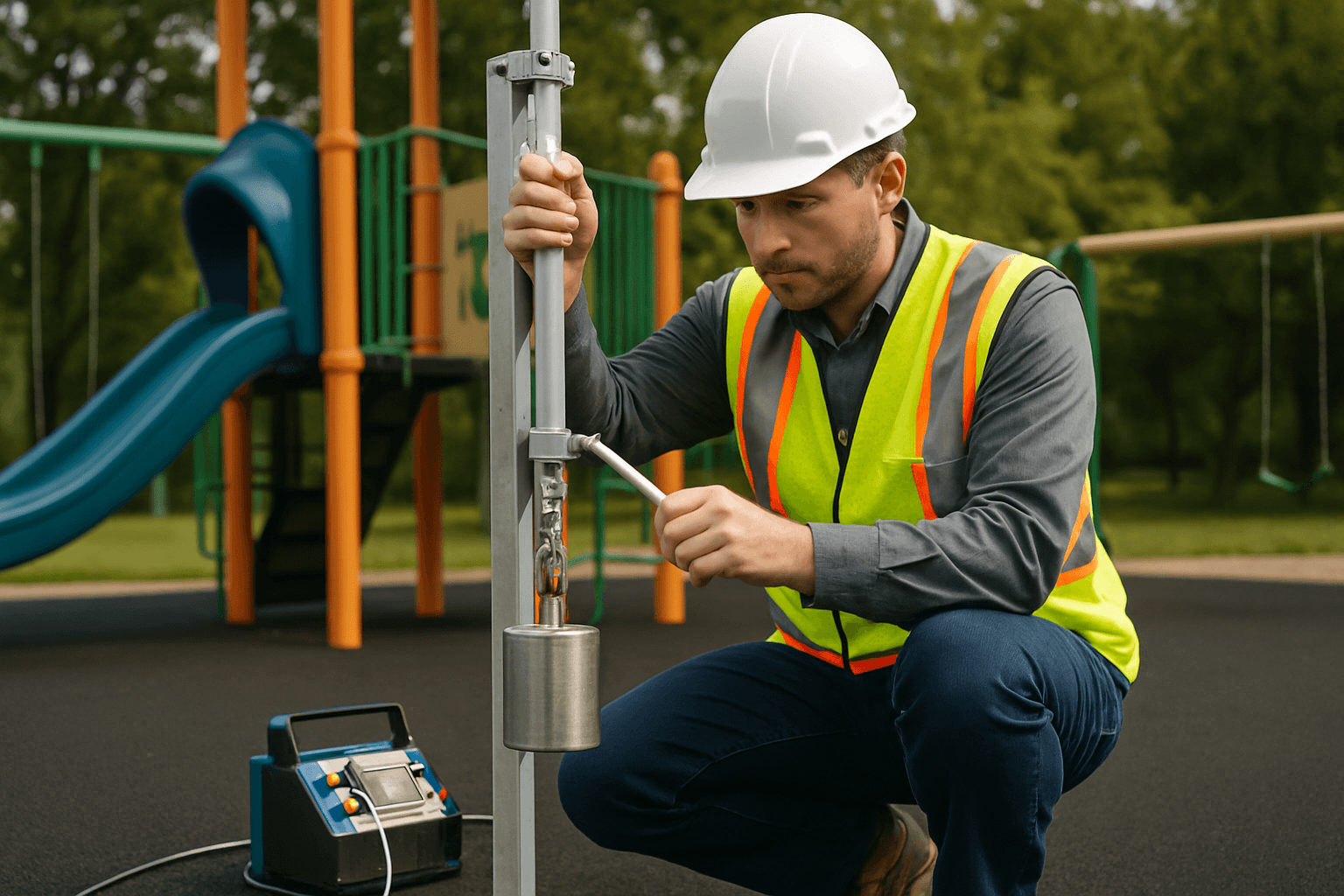
Failing an impact attenuation test is not the end of the world, but it's not a minor issue either. If your playground surfacing doesn't pass, you have a liability problem, a client relationship problem, and usually a timeline problem -- all at once. Knowing what happens next, and what caused it, is the fastest way through.
What the Test Actually Measures
Impact attenuation testing measures the surfacing's ability to reduce the force of a fall below injury thresholds. The standard is ASTM F1292. The test involves dropping an instrumented head form from defined heights onto the surfacing and recording the peak deceleration (g) and Head Injury Criterion (HIC) score.
To pass:
- Peak deceleration must be below 200g
- HIC score must be below 1000
Both numbers must come in under the threshold for every drop location tested. One failing drop fails the test.
Common Reasons for Failure
Depth is the most common culprit. Mulch compacts over time. A surface installed at 12 inches may be sitting at 8 inches by the time inspection rolls around. That loss of depth directly translates to reduced cushioning. ASTM F1292 performance is tied to depth -- if the depth isn't there, the test scores won't be either.
Contamination is the second most common issue. Soil, sand, gravel, or debris mixed into the mulch layer changes how the material compacts and absorbs impact. Rubber playground borders that have deteriorated can introduce rubber granules that behave differently from EWF under load. Even a few inches of contaminated layer at the bottom can shift your scores.
Moisture content affects results too. Saturated mulch behaves differently than mulch at normal moisture. Most standards acknowledge this, and some test protocols call for testing conditions to be documented. If your site just had three inches of rain, that can work for or against you depending on the material.
Particle degradation matters over time. EWF breaks down. Fine particles that result from foot traffic and weathering don't cushion impact the same way intact fibers do. An older installation with a lot of fines in the mix will test worse than fresh material at the same depth.
What Happens Right After a Failure
The first thing you need to know: a failed test on an occupied playground creates an immediate safety obligation. If the surface can't pass ASTM F1292 at the equipment's fall height, you have a surface that may not adequately protect kids from falls.
Most agencies and facilities managers will want the playground closed or restricted until the surfacing is corrected. That's not an overreaction -- it's the right call. Get ahead of it by recommending restriction immediately rather than waiting for them to ask.
Next, document everything. Get the test report, note the specific drop locations that failed, and photograph the surface conditions. You want a clear record of what was tested, under what conditions, and what the results were before anything is disturbed.
Your Remediation Options
Top-off to restore depth. If depth is the problem and the material is otherwise clean, a top-off is your fastest path to compliance. Add enough material to bring depth back up to or above the rated depth for your equipment's fall height. Retest before reopening.
Full replacement if contamination is the issue. If the existing material is contaminated, adding depth on top doesn't fix the base layer. You'll need to remove the existing material, address any drainage or base issues, and install fresh EWF. This is more expensive and slower, but topping off contaminated mulch is just delaying the same failure.
Targeted remediation on high-use zones. If only certain drop locations failed -- typically under swings and at slide exits -- you may be able to address those zones specifically without a full site replacement. Document the approach and retest the specific zones that failed.
Who Pays?
That depends entirely on your contract. If the surfacing was installed per spec and the failure is due to normal wear and maintenance lag, the facility owner typically owns the remediation cost. If the failure is tied to installation defects -- wrong material, incorrect depth at installation, improper compaction -- that's a contractor liability issue.
This is exactly why your spec and your installation documentation matter. If you have sign-off on installed depth and material compliance at the time of installation, you have a baseline for the conversation. If you don't, you're arguing from memory.
Prevent the Next Failure
Impact attenuation failure on an existing installation usually means one of two things: maintenance hasn't kept up with depth, or no one was checking. Both are solvable.
Quarterly depth checks at high-use zones, with documented results, catch problems before they become test failures. A simple log -- date, location, measured depth -- is enough. If depth drops below your trigger threshold, you top off before the next test, not after.
The test is not the problem. A test failure is just a very expensive way to find out your maintenance program wasn't working.