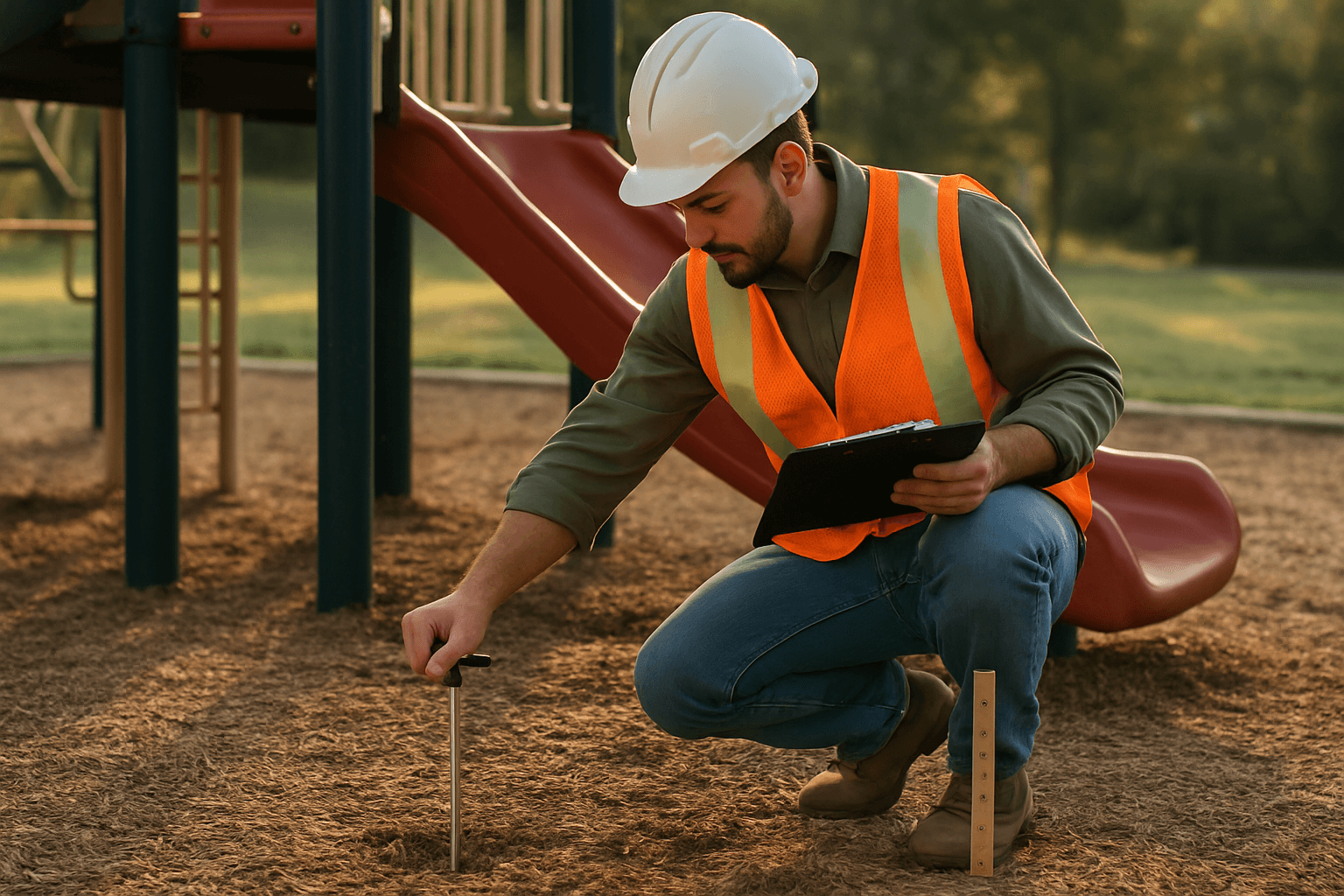
You measured 12 inches. The spec says 12 inches. The inspector shows up, sticks the probe in, and tells you it's a fail. What gives?
This happens constantly, and it's almost never because you did something wrong on purpose. There's a gap between how mulch gets installed and how it gets tested, and that gap costs contractors failed inspections, rework, and wasted material.
Here's what's actually going on and how to get it right the first time.
Settlement Is the Invisible Problem
Fresh mulch doesn't stay where you put it. The day you install, you might measure 12 inches. Three days later, that same spot could read 10 or 11 inches because the material has settled, shifted, and compressed under its own weight.
Most playground mulch specs account for this. That's why many require an initial installed depth of 12-15 inches for equipment with an 8-foot fall height, knowing it will settle down to the required minimum. If you're installing to exactly the minimum and then the inspector comes a week later, you're going to fail.
The fix is simple: know the expected settlement rate for your material and overfill accordingly. EWF settles differently than wood chips. Rubber mulch settles differently than both. Ask your supplier for settlement data if you don't have it.
Your Measuring Method Is Wrong
Here's the thing most guys don't realize: inspectors don't measure the way you do.
When you're installing, you probably measure from the bottom of your containment border to the top of the mulch. That's intuitive. But inspectors often measure from the top of the compacted sub-base, not from the bottom of the border.
If your border sits an inch above your sub-base, that's an inch of depth you thought you had that the inspector doesn't count.
The other issue is measurement location. You measure in the middle of your fall zone where the mulch looks good. The inspector measures at the critical points, which usually means right under the equipment where use zone calculations place the highest fall risk. That's also where traffic is heaviest and where the mulch gets displaced fastest.
Before the inspection, measure where the inspector will measure, not where it's most convenient for you.
Traffic Displacement Is Faster Than You Think
Between installation day and inspection day, somebody walked through your mulch. Probably lots of somebodies. Kids tested the new equipment. Workers from other trades crossed through. The client's staff came to look at it.
Every footstep moves material. The paths between equipment and the areas directly under swings and slide exits get thin fast. If your inspection happens even a few days after install, you might have visible low spots that weren't there when you left.
If you can't control site access between install and inspection, schedule your inspection as close to completion as possible. Some contractors build in a quick top-off visit right before the inspection specifically for this reason.
Your Sub-Base Isn't Flat
This one is sneaky. You install 12 inches of mulch measured from the surface. But if your sub-base has a low spot, the actual depth in that location might be 14 inches, while a high spot nearby might only have 10.
The mulch surface looks flat. The sub-base isn't. The inspector's probe finds the shallow spots.
The fix happens before mulch ever hits the ground. Grade your sub-base properly and inspect it yourself before you start spreading. Some contractors use a string line or laser level to check for deviations greater than an inch. It takes 10 minutes and saves a failed inspection.
Compaction During Install Works Against You
Some installers rake and spread, then walk across the surface to compact it slightly for a finished look. That compaction feels like you're doing a good job, but you're actually reducing your depth.
If you compact after measuring, your 12-inch install becomes an 11-inch install. Don't measure until you're done with all spreading and any intentional compaction. And if you don't need to compact, don't.
The Temperature Factor
Cold-weather installs create a specific problem. Mulch that was measured and installed at 30 degrees will expand slightly when temperatures rise. Sounds like that would help, right?
The problem is the reverse: if you install in warm weather and the inspection happens after a cold snap, the material contracts slightly and your depth reading drops. This isn't dramatic, usually less than half an inch, but if you're already at the margin, it can push you into fail territory.
For jobs that might get inspected across a season change, pad your depth by an extra inch.
How to Get It Right
Install 15-20% over spec. For a 12-inch requirement, install 14-15 inches. This accounts for settlement, compaction, and traffic.
Measure where the inspector will. Under the equipment, at the edge of containment borders, at slide exits and swing paths. Not in the middle of your nicest-looking area.
Document your installed depths. Take photos with a measuring stick immediately after install. If you can show you installed at 14 inches and the inspector measured 11.5 two weeks later, that's evidence of a specification problem or site access issue, not installation negligence.
Do your own pre-inspection. The day before the inspector comes, walk the site with a probe yourself. Top off any spots that have gone shallow.
Inspections aren't about catching you doing bad work. They're about making sure the playground is safe. If you understand what they're actually measuring and why your number might differ from theirs, you can install once and pass the first time.