The Question Every EWF Job Raises
You've got a playground resurfacing job on the calendar. The existing surface is worn down, the client wants fresh EWF, and someone on the team asks: "Are we putting fabric down first?"
Some crews swear by geotextile barriers on every job. Others say they're a waste of money that causes more problems than they solve. The truth is more situational than either camp admits, and picking the wrong answer can add cost, shorten your surface life, or come back to bite you at re-inspection.
Here's how to think through it before you show up with a load.
What a Geotextile Barrier Does (and Doesn't Do)
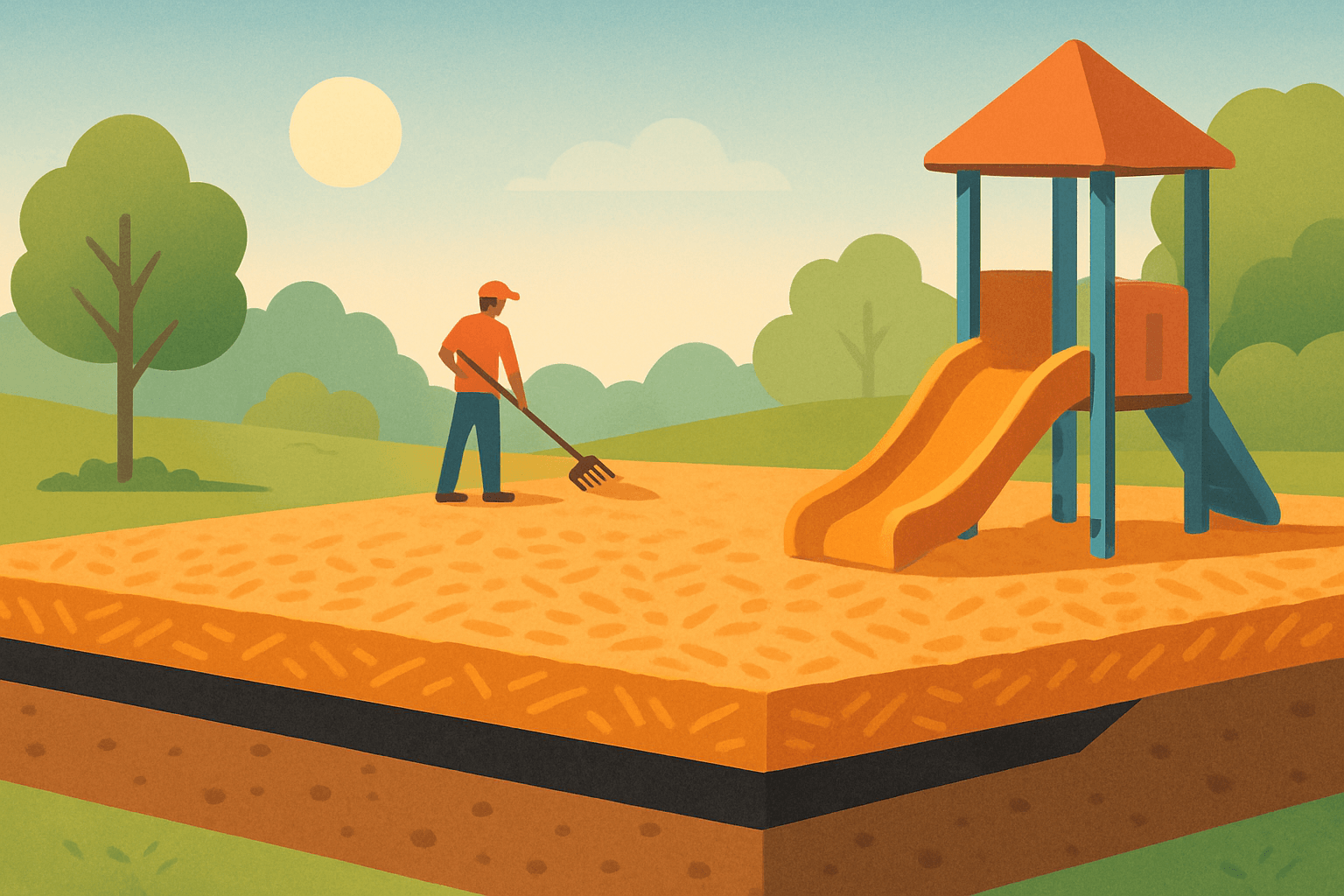
A geotextile barrier is a permeable fabric layer installed between the subgrade and your EWF. It serves two purposes: it slows the downward migration of engineered wood fiber into soil, and it keeps the clean fiber layer separate from whatever's underneath.
It doesn't prevent weed growth. Contractors sell it that way sometimes, but seeds blow in from above. A fabric layer six inches under your EWF isn't stopping dandelions. If weed suppression is the stated goal, that's a client education conversation, not a fabric conversation.
What it does do well: keeps your EWF cleaner longer in contamination-prone environments and extends effective service life in certain soil conditions.
When the Barrier Earns Its Cost
Sandy or highly permeable subgrade. Fine sand pulls fiber down faster than compacted native soils. If you're working on a sandy substrate, barrier fabric is a legitimate line item. You'll see the difference at the 18-month inspection.
Clay-heavy or poor-draining soils. This sounds counterintuitive. Clay doesn't pull fiber down, but it holds water. Standing water under EWF accelerates organic breakdown and creates anaerobic conditions that turn clean fiber into dark, decomposing material faster than expected. Fabric helps keep the layer definition clean and makes your inspection reads more reliable.
Replacement jobs over contaminated EWF. When you're pulling out badly degraded EWF that's mixed with soil and organic debris, putting fabric down before the new load creates a physical marker. When the client calls in four years wondering why depth is low, you can distinguish new fiber loss from contamination migration.
High-traffic commercial sites. More foot traffic means more compaction, more lateral displacement, and more fiber working into subgrade edge zones. Fabric extends the maintenance cycle at high-use sites.
When You Skip It
Short project timelines with clean native soil. If you're topping off an existing installation on good compacted soil and the client expects a re-inspection in 12 months anyway, the fabric adds labor and material cost without meaningful performance benefit on that timeline.
Installations over concrete or asphalt. This comes up more than you'd expect on retrofit projects. Paved substrates don't absorb fiber, so there's no migration concern and barrier fabric is unnecessary.
Projects where drainage is already constrained. Some older playgrounds have borderline drainage. Adding a fabric layer that traps sediment can reduce drainage performance over time. In those cases, you're solving a fiber migration problem you may not have while creating a drainage problem you definitely don't want.
What the Specs Say
ASTM F2075 covers engineered wood fiber specifically. It doesn't mandate geotextile barriers, but it doesn't prohibit them either. The standard focuses on wood content, fiber size, and contaminant levels in the EWF itself.
ASTM F1292 covers impact attenuation, which is the critical safety standard. Your Critical Fall Height compliance depends on depth, fiber quality, and compaction. The presence or absence of barrier fabric has no bearing on your HIC test results.
If you're working off a landscape architect spec, read it carefully. Some specs call out geotextile by product type, weight, and installation pattern. When it's specced, it's not optional. When it's not mentioned, you have discretion and should document your decision in the job record.
The Cost Math
A permeable geotextile barrier typically runs $0.15 to $0.35 per square foot installed, depending on fabric weight and your labor rate. On a 2,000 square foot playground, that's $300 to $700 added to the job.
For high-use commercial playgrounds where you're projecting annual top-offs, barrier fabric can push the interval from 12 months to 18 or 24 months by keeping fiber composition cleaner. On a $1,200 per visit service contract, the math pencils. On a small residential site with a short service window, it usually doesn't. Skip it, document your reasoning, and schedule your inspection calendar accordingly.
The Field Takeaway
Use barrier fabric on sandy or clay-heavy soils, high-traffic commercial sites, and contamination-sensitive replacement jobs. Skip it on paved substrates and short-cycle, low-use installations. Always follow written specs when they exist.
Most importantly, document your decision. Whether you use it or not, a note in the job record of why you made that call protects you at re-inspection and gives the next crew context when they show up for a top-off two years later.
GetMulch delivers certified EWF and rubber mulch to playground installation crews across the country. Need material for your next job? Get a quote at GetMulch.com.